
The Indian Navy's Republic Day tableau will showcase indigenous platforms like INS Vikrant and a stitched ship from the 5th century CE, highlighting the theme of a 'Strong Navy for a Strong Nation'.

These upcoming launches carry added significance in light of setbacks suffered in recent years.

The satellite, weighing about 4,410 kg will be the heaviest to be launched from the Indian soil and into a Geosynchronous Transfer Orbit (GTO), the space agency said. The satellite will travel onboard a LVM3-M5 rocket, dubbed as 'Bahubali' for its heavylift capability.

ISRO is set to launch its communication satellite CMS-03 from Sriharikota. The satellite, weighing 4,410 kg, will be the heaviest launched from Indian soil into a Geosynchronous Transfer Orbit (GTO).

The heaviest communication satellite to be launched from the Indian soil onboard a new generation, homegrown 'Bahubali' rocket was successfully placed into the intended orbit on Sunday, the Indian Space Research Organisation said.

ISRO Chairman V Narayanan announced the development of a massive rocket capable of placing 75,000 kg payloads in low earth orbit, highlighting India's growing space capabilities and future satellite launches.

The 4,700 kg GSAT-N2 High-throughput (HTS) satellite has been injected into the desired orbit, NewSpace India Limited (NSIL) said in a series of posts on microblogging site 'X.

'The solution is to replace, clean up, retest and proceed.' 'There is nothing to worry about if corrected.'

India will launch two satellites over the next two years to augment transponder capacity and make contingency arrangements to support services like VSAT, television, strategic and emergency communications.

The 3,357-kg satellite, which was deployed from the lower passenger position of Ariane-5 launch vehicle (VA 251) into the geostationary transfer orbit, is configured on ISRO's enhanced I-3K Bus structure to provide communication services from Geostationary orbit in C and Ku bands.

GSAT-18, which aims at providing telecommunications services for the country by strengthening ISRO's current fleet of 14 operational telecom satellites, was launched into a Geosynchronous Transfer Orbit about 32 minutes after the lift-off.

The 3,357-kg satellite is slated to blast off from the Ariane Launch Complex at Kourou, a French territory located along the northeastern coast of South America, at 02:35 hrs IST. "GSAT-30 is to serve as a replacement to INSAT-4A spacecraft services with enhanced coverage", ISRO said.

"Efforts are underway to establish the link with the satellite," it added.

ISRO Chairman K Sivan described the GSAT-11 as the "richest space asset" for India.

GSAT-6, the country's latest communication satellite has been successfully positioned in its orbital slot, Indian Space Research Organisation said on Sunday.

A high power satellite, GSAT-15 is being inducted into the INSAT/GSAT system. GSAT-15 carries a total of 24 communication transponders in Ku-band as well as a GPS-Aided GEO Augmented Navigation (GAGAN) payload operating in L1 and L5 bands.
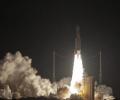
Boosting India's communication services, its latest satellite GSAT-16 was successfully launched on board Arianespace rocket from the spaceport of Kourou in French Guiana in the early hours of Sunday, after a delay of two days due to bad weather.

It also carries equipment for meteorological data relay and satellite based search and rescue services being provided by earlier INSAT satellites.
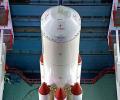
India on Friday successfully launched its latest communication satellite GSAT-12 onboard a powerful variant of homegrown Polar Satellite Launch Vehicle, PSLV-C17, from the spaceport in Sriharikota.

Weighing about 5,854 kg, GSAT-11 would play a vital role in providing broadband services across the country, and also provide a platform to demonstrate new generation applications.

"First orbit raising operation of GSAT-6 was successfully completed by firing the Apogee Motor for 3385 seconds at 8:35 pm IST on August 28," the ISRO said.

India's advanced communication satellite GSAT-10, the heaviest built by the country, was launched in the early hours of Saturday on board Ariane-5 rocket from Europe's spaceport in French Guiana.
The 'context' of the launch of GSAT-15 highlights that India has much ground to cover in the transponder arena while in satellite navigation arena ISRO's progress has been satisfactory, says Ajey Lele.

Arianespace launch vehicle Ariane-5 VA-231, carrying GSAT-18 along with co-passenger Sky Muster II for the Australian operator nbn (National Broadband Network) was scheduled for launch at 2am on Wednesday.
India's latest communication satellite GSAT-8 was successfully launched on Saturday by Arianespace from Kourou in French Guiana to give a boost to direct-to-home services in the country.

India's advanced multi-band communication satellite GSAT-7, launched from French Guiana by European space consortium Arianespace's Ariane 5 rocket on August 30, has been successfully placed in the geosynchronous orbit with an altitude of about 36,000 km above earth's surface.

India's first exclusive defence satellite GSAT-7 was successfully launched by European space consortium Arianespace's Ariane 5 rocket from Kourou spaceport in French Guiana on Friday, giving a major push to the country's maritime security.

The satellite would provide a thrust to mobile communication through multi-beam coverage facility, the ISRO said.

ISRO Chairman K Sivan said there might by a postponement if the weather was not conducive.

The ISRO lost communication with the satellite when it attempted to ignite the engine in a third and final move to its desired location.

'With India's growing capabilities in the space sector, this creates promising opportunities for enhanced collaboration and market access.'
The GSAT-12 communication satellite, launched onboard PSLV-C17, has been successfully placed in geosynchronous orbit with a perigee of 35,684 km, apogee of 35,715 km and an orbital inclination of 0.17 deg with respect to the equatorial plane.
The feat is the second one for the Indian Space Research Organisation scientists in using the indigenously made cryogenic stage after the January 5, 2014 launch of GSLV-D5.
India's 3,400-kg communication satellite GSAT-10 is now ready to be shipped to the spaceport at Kourou in French Guiana for launch by European space consortium Arianespace in two months, according to Indian Space Research Organisation Chairman, K Radhakrishnan.

Hit by inclement weather, the launch of India's latest communication satellite GSAT-16 was deferred for the second time after it was rescheduled to be put into space in the early hours on Saturday by Ariane 5 rocket from the space port of Kourou in French Guiana.

Sabka sath, sabka vikas, said Maldives President abdulla Yameen.
The telescope was designed to be launched aboard a Russian launcher at a cost of $15 million and another $3.2 million is being spent to adopt it to the Indian launcher, sources at the ISA said.
The apogee [farthest point] is 36,000km and the inclination of the orbit with respect to the equatorial plane has been reduced from 7.37 degrees to the present 0.32 degrees,
 © 2026 Rediff.com - Advertise with us - Disclaimer - Privacy Policy - Sitemap - Feedback - About us - Terms of use - Grievances